




Introduction
The Smart Mobile QA Techniques are gaining significance owing to the increasing complexity and capability of mobile applications along with their dependence on a variety of devices and operating systems. Although many organizations believe that Mobile Application Test Automation is directly proportionate to good application quality, this concept is not adequate in 2026 because automating all tests does not guarantee an optimum result.
The reality is that modern Mobile QA Strategies 2026 requires a experienced, smart, risk-based approach instead of an automation-first mindset. Smart quality assurance is the combination of smart automation of software quality assurance with the application of AI tools to test, analyse risks, perform exploratory testing, and human knowledge for identifying problems that cannot be detected by scripts alone. In terms of success evaluation criteria, successful QA teams no longer count tests but concentrate on increasing the quality of their products and confidence of releases.
Executive summary
Smart Mobile QA Strategies are set to redefine the way companies are ensuring software quality in 2026. Rather than implementing automation wherever possible, efficient teams have learned to leverage automation to its full potential and depend on manual testing for usability testing, exploration testing, and critical user actions.
“AI-Powered Mobile Testing” is yet another game-changer, revolutionizing the way we create tests, discover defects, and maintain them; however, it should be done in conjunction with human efforts rather than substituting them. Applying the risk-based Test Automation strategy will allow one to prioritize more complicated functionalities and minimize costs.
In this article, you’ll learn why relying on automation first and foremost is simply impossible, how to develop a good ratio of automation and manual tests, about the increasing role of artificial intelligence in the mobile QA sphere, and effective ways of developing smart testing procedures.
Why automating everything is a mistake
Many teams believe that increasing Mobile App Testing Automation ensures good software quality. In reality, automating every test creates challenges that reduce capability instead of improving it. Following mobile QA best practices means using automation strategically instaed universally.
Rising maintenance costs
Automation scripts need constant maintenance in case there is any alteration to the application under test. The smallest change to a login form or the way a button is located in the script may render thousands of test scripts useless, leading to wasted effort by QA professionals.
Flaky automated tests
Automated testing may be affected by issues such as network instability, latency, or device-specific behaviour. This means that a checkout test may fail due to a loading screen delay, even if the program is functioning properly.
Frequent mobile OS & device updates
However, with constant change in mobile eco-system with respect to Android versions, iOS versions, screen size, device fragmentation, and so forth, a functionality that may work perfectly well on a Google Pixel will suddenly start failing on a Samsung device because of different UI rendering.
False confidence from excessive automation
High automation coverage does not necessarily mean high quality. A team may report 95% automated test coverage, yet real users still encounter navigation problems, crashes, or performance issues that scripted tests never evaluate.
Missed usability & UX issues
Automation cannot fully assess gesture responsiveness, accessibility, visual consistency, or overall user satisfaction. Human testers can easily identify confusing layouts or poor touch interactions that automated scripts cannot recognize.
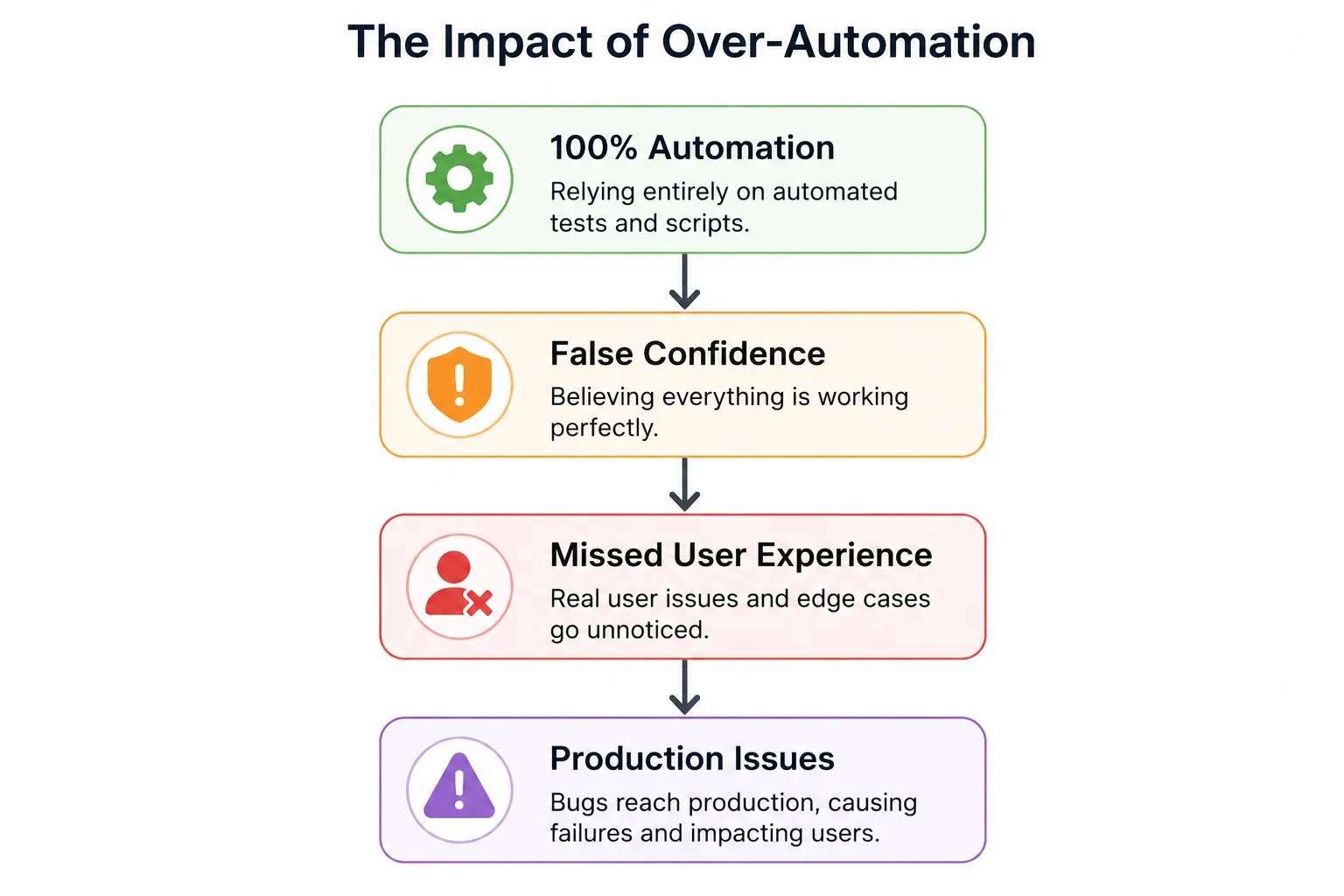
Industry challenges
- Device fragmentation across Android and iOS ecosystems
- Increasing maintenance overhead for automated scripts
- Flaky and unstable test execution
- Slower feedback cycles caused by frequent script failures
A balanced testing strategy delivers more reliable results than attempting to automate everything.
The shift toward smart mobile QA strategies
Smart Mobile QA Strategies are transforming the way organizations approach software quality in Mobile QA Strategies 2026. Rather than measuring success by the number of automated tests, modern QA teams focus on delivering the greatest business impact with the right testing approach.
Quality over quantity
It is not about automating all cases, but automating the test cases that give us the greatest return. Impact-driven test automation helps in minimizing the maintenance work, faster releases, and happier customers since we are focusing on the features that really matter.
Risk-based testing
The risk-based test automation strategy emphasizes that the tests should be performed on those features whose risk levels are high compared to other, less risky features. It is important to test payment options, authentication, logging in and logging out processes, and check out processes, as their impact is critical to the business.
User-centric quality assurance
Successful QA teams think like end users rather than scripts. They validate complete customer journeys, accessibility, performance perception, and usability to ensure the application delivers a seamless experience across different devices and conditions.
For organizations looking to expand their testing strategy beyond automation, our guide on Advanced QA testing techniques explains how Browser DevTools can help QA engineers improve debugging, performance analysis, and overall testing effectiveness.
Key takeaway
A good QA team measures its performance in terms of effectiveness and not automation percentages. The synergy that comes from blending the automation philosophy with manual skills and business aspects yields improved quality, faster deployment, and happier customers than aiming for 100 percent automation.
What tests should be Automated vs. what tests should stay Manual
In line with Mobile QA Best Practices, one must realize that not all tests need to be automated. It takes a proper combination of both automation and manual processes in QA to achieve the best results.
| Automate | Keep manual |
| Login | UX evaluation |
| Regression testing | Exploratory testing |
| API validation | Accessibility review |
| Smoke tests | Visual consistency |
| Performance monitoring | New feature exploration |
| Repetitive calculations | Human behaviour testing |
Regression testing is the best use case for automated testing, because it helps keep previous software components working properly when new versions come out. Smoke testing can be used to confirm that essential functions are still operational after release, and API validation testing is useful for checking communication between servers.
However, manual testing can detect problems that cannot be detected through automation. Exploratory testing allows test engineers to find out problems that would not have been discovered otherwise because they work in a natural way within the application. Usability testing will determine if the software is easy to use, while visual testing will make sure that the layout and font display properly on different platforms.
To learn more about the importance of manual testing, especially exploratory techniques, read exploratory testing for software quality assurance. The best QA strategy is not choosing automation over manual testing—it is using both where they create the greatest value.
The best QA strategy is not choosing automation over manual testing—it is using both where they create the greatest value.
SMART framework for mobile QA in 2026
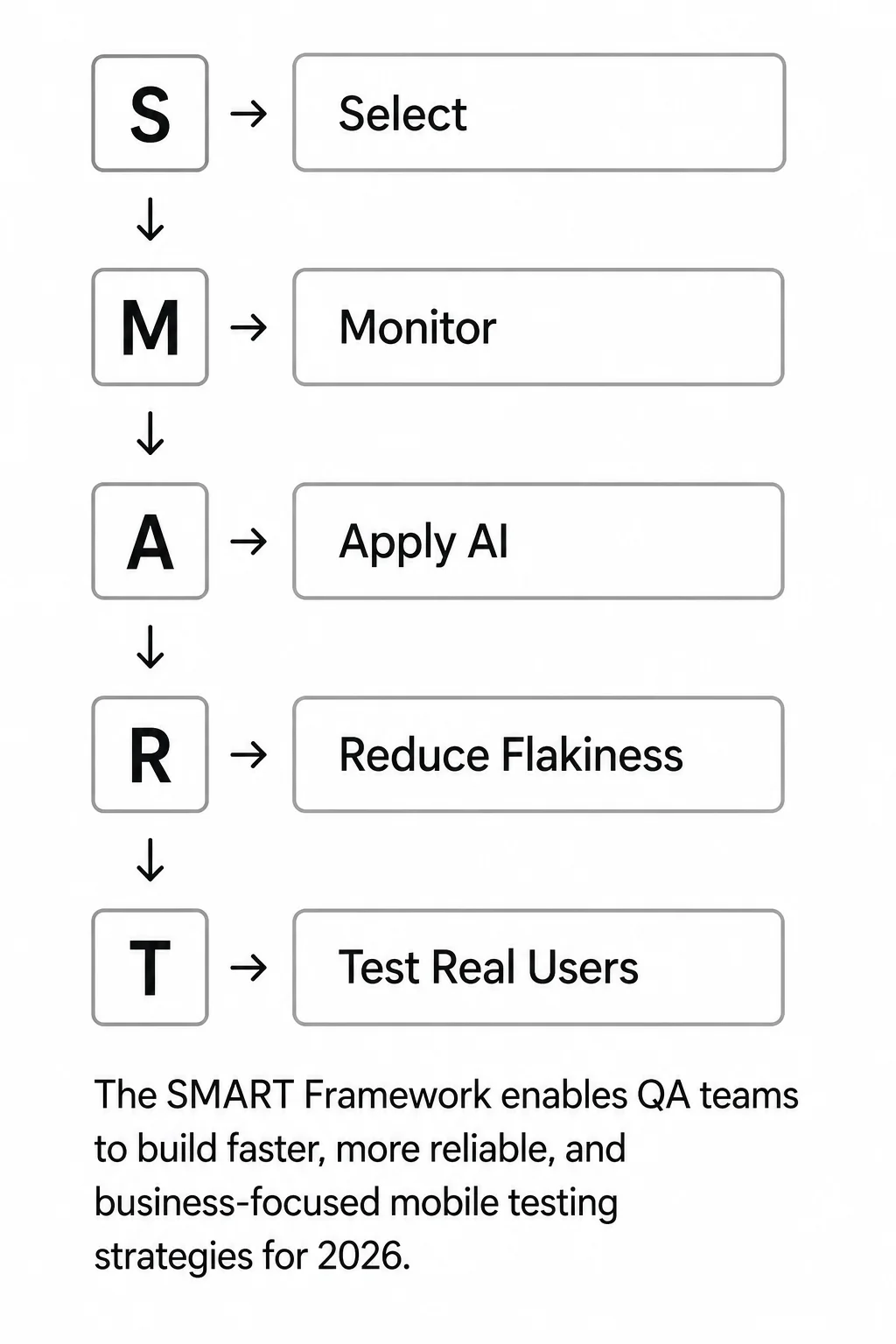
Modern mobile testing requires a strategic approach rather than simply increasing automation. The SMART Framework helps QA teams focus on quality, efficiency, and real user value.
S – Select high-value test cases. Not every feature deserves automation. Focus on critical business processes that happen often. For instance, having the checkout process automated is much more valuable than having an FAQ page automated since the FAQ page doesn’t change often.
M – Monitor automation ROI. Automation should be measured continuously to ensure it provides value. Teams should track key metrics such as:
| Metric | Purpose |
| Maintenance time | Effort required to update scripts |
| Execution time | Speed of test completion |
| Failure rate | Percentage of flaky or failed tests |
Maintenance costs that surpass the benefits of saved time indicate that a re-evaluation of the automation approach is necessary.
A – Apply AI-assisted testing
AI-powered mobile testing increases efficiency by automatically creating test cases, using self-healing locators when UI components are altered, and identifying failure causes. By employing AI, repetitive tasks can be eliminated, enabling QA testers to focus on more complex tests.
R – Reduce flaky test suites. Flaky tests make automation less trustworthy. Testers can avoid making their tests flaky by employing reliable locators, employing explicit waits rather than hard-coded waits, and keeping tests isolated to prevent one failing test from interfering with other tests.
T – Test real user experiences. Testing should be done in situations where there is poor internet connectivity, power saving mode, background noise, and notifications. This type of testing will simulate realistic user interaction and help uncover issues not detected by automated tests.
SMART framework diagram
The role of AI in mobile QA testing
AI-driven Mobile Testing is revolutionizing quality assurance through intelligent, agile, and rapid test automation. Rather than depend only on the manual creation of test scripts, tests can be created based on the analysis of app workflow and user behavior, which will cut down the effort involved in test suite creation.
Another significant benefit is that of self-healing automation, which enables the AI to fix any broken element locators in case of any UI changes, thus avoiding any maintenance and test failures. AI also contributes significantly to visual verification by recognizing any unexpected layout changes, missing objects, and design inconsistencies on different platforms.
In addition, predictive defect analysis helps identify components with higher likelihood of having defects using past data from tests and enables the team to concentrate on areas of significance. Intelligent prioritization also comes in handy in terms of selecting which tests to run based on risks involved and recent coding changes.
# Example pseudo-code for AI-assisted prioritization

if risk_score > 80:
    execute_tests("critical_suite")
else:
    execute_tests("smoke_suite")
The combination of AI strengths and human knowledge will help the QA team increase coverage, minimize maintenance time, and develop better mobile applications.
Real-world mobile QA scenarios
The real-world mobile application can get the maximum use of a mixture of both automation and manual testing methods to provide the best results.
Scenario 1: E-commerce mobile App
In the case of an e-commerce system, automation must be applied to key processes that involve login, management of the cart, check-out, and payment process. This is because these features are often used, and they must operate reliably in all releases. However, manual testing is required to validate promotions, user experience, and user journey. Testers can confirm if the right discount appears, whether navigation is easy, and if the user experience is good.
Scenario 2: Banking mobile App
Automation suits authentication, transactions, and security in banking applications because the processes require accuracy and consistency. Testing manually will focus on accessibility, error messages, and user experience. For instance, manual testing will involve assessing the clarity of error messages, accessibility of the application by users with accessibility requirements, and enabling users to perform their financial transactions with confidence.
The above scenarios clearly illustrate that the best mobile QA approach is one that automates key processes while manually testing others.
Mobile QA trends for 2026
Mobile QA Strategies 2026 are shifting from automation-focused approaches to intelligent, value-driven testing. AI-Powered Mobile Testing is enabling automated test generation, self-healing scripts, and predictive defect analysis, reducing maintenance efforts. At the same time, risk-based testing helps teams prioritize critical business features, while shift-left testing identifies defects earlier in the development cycle.
Organizations are also adopting cloud device labs to validate applications across diverse devices and operating systems, supporting continuous integration and continuous testing. Additionally, Visual AI validation is improving UI consistency by automatically detecting visual regressions across screens and resolutions.
| Approach | Approx. maintenance | ROI |
| Full automation | High | Medium |
| Smart automation | Medium | High |
| Balanced QA strategy | Low–medium | Highest |
These trends demonstrate that the future of mobile QA lies in combining AI, strategic automation, and human expertise to deliver faster releases, better user experiences, and higher long-term returns on investment.
Expert insights
“The most effective QA teams in 2026 will not be those with the highest automation coverage. They will be the teams that automate strategically while applying human expertise to usability, accessibility, and complex real-world scenarios. Success is measured by business impact and user satisfaction—not by the percentage of automated tests.”
Common mistakes to avoid
- Automation of unstable features: Unstable features necessitate frequent revisions to test scripts, thereby raising maintenance costs.
- Ignorance of exploratory testing: Using automation exclusively means some problems may go undetected during the process.
- Evaluation based on automation percentage: Automation level is not directly related to the quality of the software being tested.
- Lack of ROI measurement: Not considering ROI for automation leads to spending much more than one gains.
- Not accounting for device fragmentation: Testing on a few devices ignores possible problems on other versions of Android and iOS.
- Failure to conduct UX testing: Automation cannot address all concerns regarding usability, accessibility, and user experience.
Mobile QA checklist for 2026
- Automate repetitive and stable test cases.
- Prioritize high-risk business workflows.
- Use AI-assisted testing where it adds value.
- Monitor automation ROI regularly.
- Perform exploratory testing for hidden defects.
- Test on real devices and environments.
- Reduce flaky scripts through best practices.
- Validate UX and accessibility manually.
- Track performance continuously.
- Review and refine your automation strategy regularly.
Conclusion
Smart Mobile QA Strategies recognize that automation is a powerful tool, but it should never become the ultimate goal. The most effective testing approach combines strategic automation with manual expertise to validate usability, accessibility, and real-world user experiences. While AI is transforming mobile testing through intelligent test generation, self-healing scripts, and risk-based prioritization, it enhances human decision-making rather than replacing it.
Adopting Mobile QA Best Practices means focusing on business-critical features, measuring automation ROI, and balancing speed with quality. Organizations that embrace Smart Mobile QA Strategies can reduce maintenance costs, accelerate release cycles, improve customer satisfaction, and minimize production risks.
Ultimately, success is not measured by achieving 100% automation coverage but by delivering reliable, high-quality mobile applications that meet user expectations and drive stronger business outcomes.