





Introduction
➤ n8n has become a widely popular and preferred workflow for companies looking to streamline processes using no-code platforms and reduce the daily manual effort required for the same work.
➤ While other workflows focus solely on rule-based automation, modern businesses now require intelligent and largely custom decision-making, which is where AI workflows come into play.
➤ AI workflows combine n8n automation with artificial intelligence to understand and act in data more Precesilly. Large Language Models (LLMs) will enhance these workflows to interpret the natural language, generate content according to user needs, and make decisions based on that.
➤ In this blog, we will explore how we can build advanced AI workflows in n8n using LLMs, helping organizations to go beyond simple automation toward intelligent workflows by using LLM in n8n.
What this blog covers
- AI workflows are different from traditional n8n workflows.
- The importance of LLMs in intelligent automation.
- Practical utilization of LLM-powered workflows
- Workflow design concepts are described step by step.
What are advanced AI workflows in n8n?
➤ Advanced AI workflows in n8n explore the new possibility to dynamically read user data information, execute decisions, and produce outputs with the utilization of AI models. Unlike traditional automation, which only relies on specific rules, AI workflows often understand the organization’s intent and context.
➤ In simple terms, AI models allow organizations to think before they act for n8n workflows.
➤ Below is the real world example of how we can use this:
- Consider the customer support workflow :
- When a new support email arrives → remove the sensitive information before passing to LLM → send filter email content to LLM → routes the ticket to the particular department → draft the response as per needs → logs the response in CRM system.
Here, in the above-mentioned example workflow not just about moving the information manually in the system. It understands the customer’s request and processes information intelligently.
This approach drastically reduces response time, manual time, and human error of users and also improves the consistency and enables automation in the scenarios that were previously manually handled.
Why use LLMs in n8n Workflows?
➤ LLMs provide the intelligence layer for workflows. n8n LLM integration helps to handle unstructured and unclassified data, such as text and feedback, allows for summarising the text from documents, and also classifies the sentiment from conversations, whatever the business needs.
➤ Some of the most popular use cases are as follows :
Summarization of text
- LLMs will summarise the long emails, reports, and meeting transcripts, and it will be easier for users to process and use the summarised data.
Data classification
- Workflows will automatically classify content such as support tickets, survey responses, or sales leads based on intent, urgency, or topic according to business needs.
Decision routing
- Based on LLM prediction, we can dynamically choose a specific path instead of static if-else conditions.
Generating content
- LLMs can generate content and recommendations based on user questions and needs.
- By integrating LLMs with n8n, we can move normal automation to intelligent workflows.
How LLM integration Works in n8n
➤ If you are new to n8n and not known how n8n works you can check our blog getting started with n8n.
➤ LLM integration with n8n follows the simple structure flows:
Input source:
- It defines where the data comes from, triggers such as emails, forms, APIs, or databases, or webhooks.
Pre-processing:
- As mentioned earlier, we can’t pass the sensitive information to LLM due to security reasons, so before passing to LLM, we need the workflow to clean, format, or structure the input for better readability and remove the sensitive information.
Prompt layer:
- What type of output business needs, users need to provide Instructions to the LLM describing what it should do with the input.
LLM processing:
- Based on the prompt layer, the model will generate or analyse content and provide the output in the required format, and pass it to the next n8n node.
In n8n, LLMs behave like processing nodes for companies. They do not replace any workflows or their logic — they simply enhance them according to user needs.
LLM Prompts act as the control mechanism for workflows. Inputs act as context for logic, and outputs act as decision data. This separation of input, prompts, and outputs keeps n8n OpenAI workflows modular, readable, and maintainable.
Instead of hard-coding and using static business logic, companies can express logic in structured natural language through prompts and business needs.
Step-by-step: Building an AI Workflow in n8n Using LLMs
Below is the workflow design for the production system with the help of production systems.
Step 1: Receives data through the trigger
This is the step to start the workflow from a trigger, such as:
- New request
- HTTP API request
- From Submission
- Webhook update
Step 2: Clean up stage
Before sending data to LLM, we need to clean up the data, such as:
- Remove unnecessary text
- Normalize the format to require LLM format
- Extract the key data
- Reduce the token size
Step 3: LLM processing with prompts
Now building AI workflows in n8n with structured input along with a prompt. The prompt defines the following:
- The task
- The required output format
Step 4: Output with LLM response
The response with LLM checked for the following:
- Missing values and fields
- Unexpected output formats
- Empty and null response
Step 5: Decision routing
Based on the output generated by LLM, the n8n flows choose the next execution as follows:
- Trigger the API call
- Store the data
Step 6: Final stage
The flow is complete with actions such as :
- Sending the update email
- Update the Database
- Notify the team members
- Creating tasks with that data
Step 7: Error handling stage
Most of the production-worthy n8n flows will have this error handling stage as follows :
- API timeout handling
- Default fallback responses
As there are multiple stages, we will consider this as a multi-step flow to find out more about this. Check out our blog about multi step workflows in n8n.
Real-world use case: Finding customer email sentiment using n8n and LLMs
➤ Understanding the user intent and sentiment for writing the email or message to strengthen customer relations. However, reading the long manual email and evaluating of customer email is both time-consuming and error-prone.
➤ Using n8n workflow with LLMs, organizations can automate sentiment intent while maintaining high accuracy and scalability.
Current problem
➤ Customer emails come in large amounts with different tone and intents. Customer support and PM teams often struggle to identify the following:
- Dissatisfied or frustrated customers due to service down or any other reason
- Urgent complaints or service down
- Positive feedback
- Neutral inquiries
➤ Late identification of negative sentiment can directly impact customer satisfaction and future work.
Workflow overview
A new email will trigger the workflows in n8n.
2. The email data will be cleaned.
3. The workflow sends the content to the LLM for sentiment.
4. The LLM returns.
4.1. Sentiment classification as follows: positive, neutral, negative.
5. Based on the sentiment results given by LLM:
5.1. Negative sentiment emails are sent to the manager automatically.
5.2. Positive emails are sent for feedback.
5.3. Neutral emails follow the standard support flow, and for future planning.
Prompt strategy
- The prompt strategy instructs the LLM model to return output in a structured format with sentiment and with one line justification.
Business impact
➤ This AI workflow automation with n8n helps the following:
- Faster identification of the unhappy customers.
- It will improve the response, and the manager prioritises the work.
- Better customer support insights.
Below is the practical demonstration of the flow
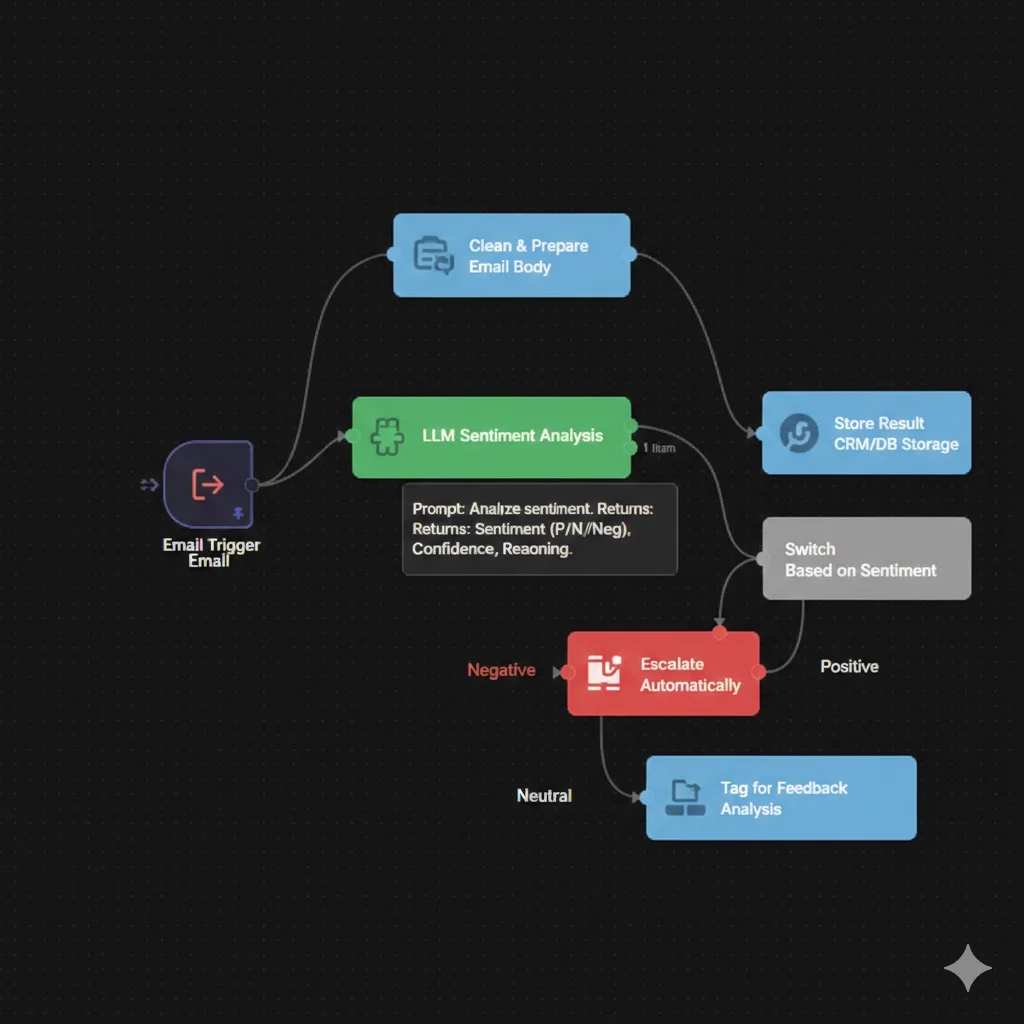
- This real-world use case example demonstrates how n8n and LLMs together enable intelligent, business-ready automation beyond traditional rule-based workflows.
Best practices for AI workflow automation in n8n
➤ Best practices of advanced workflows using n8n and LLMs are as follows :
➤ Prompt Designing
AI model’s prompts should be as follows :
- Clear and to the point as per the user’s need
- Structured clearly with the instructions
- Output-format oriented and understandable for the targeted audience
- A proper prompt is the foundation for reliable automation
➤ Token usage and cost control
- Send only the required data, removing the extra spaces and unnecessary content
- Avoid long paragraph data unless necessary
- Use proper system instructions to avoid overuse of the token
- Monitor the token usage regularly
➤ Error handling and backup model
- AI model’s prompts should be as follows :
- Clear and to the point as per the user’s need
- Structured clearly with the instructions
- Output-format oriented and understandable for the targeted audience
- A proper prompt is the foundation for reliable automation
➤ Token usage and cost control
- Send only the required data, removing the extra spaces and unnecessary content
- Avoid long paragraph data unless necessary
- Use proper system instructions to avoid overuse of the token
- Monitor the token usage regularly
➤ Error handling and backup model
- Always remember the following :
- LLMs may fail due to token quota completion.
- Sometimes it will generate incorrect output, or the format may vary.
- For these cases, use retries and validation rules. We can also choose the following way :
- Pass the model with a null response in case of LLM failure.
- If an LLM response is always needed organization can use a backup model in case of the first model failure, which improves the accuracy and success criteria for LLM-powered automation of n8n.
➤ Monitoring workflows
- Production AI workflow must be monitored for the following :
- Check the execution logs
- Check the quality output sampling as per needs
- LLM cost tracking
- Check error frequency and type of error for smooth runs
Most frequently asked question in FAQ
➤ Yes. n8n will integrate with OpenAI directly and can also connect to other LLM providers using API and HTTP nodes.
➤ No n8n is no code platform, so it does not require any coding skills.
➤ Using error handling and validation check, we can handle failures.
Conclusion
➤ n8n has already provided its value in building flexible and scalable automation pipelines as no code platform. By integrating LLMs, these workflows gain the ability to understand language, interpret intent, and generate meaningful outputs with sentiment.
➤ Advanced AI workflows in n8n enable businesses to automate processes that previously required human judgment. From content processing to decision routing, LLM provided AI workflows in n8n expand what is possible with workflow platforms.
➤ As AI models continue to grow, the combination of n8n and automation will play a central role in building adaptive, efficient, and future-ready business solutions. Leveraging AI-driven workflows is no longer experimental — it is becoming a core capability of modern digital operations for future developments.
About August Infotech
➤ At August Infotech, we adapt the fact that technology should help people rather than confuse them. As an experienced offshore development company, we’ve spent years helping businesses all over the world with developing smarter, faster, and more scalable applications.
➤ As a team we are already using this no code platform n8n and building flows with using LLMsWe listen, cooperate, and deliver with heart. Because at August Infotech, your success is also our story